Evaluating the Construction Social Media Post Template for Digital Marketing
In the competitive landscape of the construction and home improvement industry, visual communication plays a pivotal role in attracting clients. A Construction Social Media Post Template serves as a foundational design asset tailored specifically for contractors, renovators, and handymen who need to maintain a professional online presence without investing excessive time or resources into graphic design. These templates are pre-designed layouts that allow business owners to insert their specific project photos, contact details, and branding elements quickly. Understanding the utility, limitations, and strategic application of such templates is essential for any trade professional looking to optimize their digital marketing efforts.
Understanding the Asset and Its Core Function
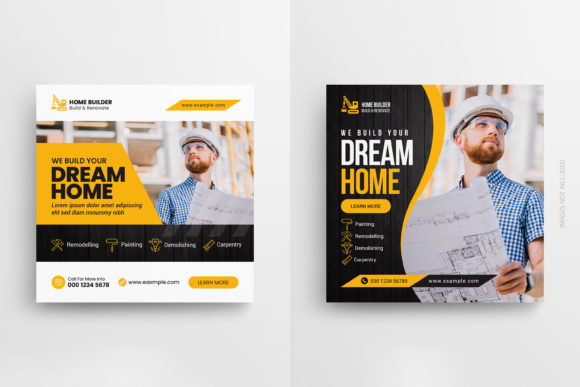
At its core, a construction social media template is a digital file, typically provided in formats compatible with industry-standard software like Adobe Photoshop. The primary function of this asset is to streamline the creation of marketing materials such as Instagram posts, Facebook updates, or web banners. A standard offering in this category often includes fully editable PSD files, sized correctly for social platforms (commonly 1080x1080 pixels for square posts), and organized with layers that separate text, background images, and graphical elements.
When evaluating a specific template, such as one designed for renovation flyers or handyman services, it is important to note what is included and what is not. Typically, these packages provide the structural design—the typography, color schemes, and layout logic—but do not include the actual photography used in preview mockups. This distinction is crucial for setting realistic expectations; the buyer acquires the framework, not the finished product. The value lies in the ability to swap placeholder images with high-quality photos of actual completed projects, thereby creating authentic marketing content.
Strategic Benefits for Trade Professionals
The decision to utilize a pre-made template often stems from a need for efficiency and consistency. For construction businesses, time spent on administrative tasks like graphic design is time taken away from billable work on-site. A well-organized template mitigates this trade-off by reducing the production time for a single post from hours to minutes. Users with only basic knowledge of editing software can modify text, adjust colors to match company branding, and replace images without needing advanced technical skills.
Furthermore, consistency in visual identity is a significant benefit. When a potential client scrolls through a contractor's social media feed, a cohesive look reinforces brand recognition and professionalism. Templates ensure that font choices, spacing, and color palettes remain uniform across different posts, whether advertising a kitchen remodel, a bathroom repair, or general handyman services. This visual reliability can subtly influence a customer's perception of the business's attention to detail and reliability.
Technical Considerations and Requirements
Before selecting a Construction Social Media Post Template, users must assess their technical capabilities and software access. Most high-quality templates are delivered as PSD files, which require Adobe Photoshop to edit effectively. While some users may possess this software, others might rely on free or alternative tools that may not support layer structures or specific font rendering in the same way. It is vital to verify that the template features "well-organized" layers, as this determines how easily a non-designer can navigate the file to make necessary changes.
Another critical consideration is the resolution and color mode. Professional templates are usually set to RGB color mode at 72 DPI, which is the standard for digital screens. If a user intends to use the design for print materials, such as physical flyers or business cards, they must ensure the template can be adapted to CMYK color modes and higher DPI settings (typically 300 DPI) without losing quality. Using a screen-optimized template for high-resolution print jobs can result in pixelated or blurry outputs, so understanding the intended medium is a key part of the evaluation process.
Ideal Use Cases and Scenarios
This type of template is a strong fit for small to medium-sized construction firms, independent handymen, and renovation specialists who manage their own marketing. It is particularly valuable for businesses that regularly complete projects and have a steady stream of "before and after" photography but lack the internal resources to design graphics from scratch. Situations where speed is essential, such as promoting a limited-time offer or showcasing a just-completed job while the site is still fresh in the client's mind, are ideal scenarios for using editable templates.
Additionally, these assets are beneficial for marketing agencies managing multiple trade clients. By purchasing a versatile template, an agency can rapidly deploy campaigns for different contractors simply by swapping out the imagery and contact information, ensuring a quick turnaround for their clients' social media needs.
When to Consider Alternatives
While templates offer convenience, they are not the solution for every situation. If a business requires a highly unique brand identity that deviates significantly from standard grid layouts, a custom design created by a professional graphic designer may be a better investment. Templates, by nature, are used by many people; there is a possibility that another local competitor could be using the same or a very similar design, which might dilute brand distinctiveness.
Moreover, if a business owner has zero familiarity with image editing software and no interest in learning the basics, a template may become a source of frustration rather than a tool. In such cases, subscription-based online design platforms that offer drag-and-drop interfaces specifically built for non-designers might provide a more user-friendly alternative, even if they offer slightly less control over fine-tuning details compared to a native Photoshop file.
Making an Informed Decision
Selecting the right digital asset involves balancing cost, time, and desired output quality. A Construction Social Media Post Template represents a cost-effective middle ground between hiring a designer for every post and creating amateurish graphics without guidance. To determine if this aligns with your goals, evaluate your current workflow: Do you have high-quality project photos ready to use? Do you have access to the necessary software? Is maintaining a consistent posting schedule a current challenge?
If the answer to these questions suggests a need for structure and speed, investing in a clean, editable template is a logical step. However, success depends on the quality of the content you insert. The template provides the frame, but the credibility comes from the real images of your work and the clarity of your message. By understanding both the capabilities and the constraints of these tools, construction professionals can leverage them to build a stronger, more visible online presence that effectively converts viewers into clients.