Strategic Advantages of School Admission Social Media Post Design for Enrollment Growth
In the competitive landscape of educational marketing, the difference between a full roster and empty seats often comes down to how effectively an institution communicates its value proposition. School Admission Social Media Post Design is not merely about creating aesthetically pleasing graphics; it is a strategic instrument used to capture attention, convey trust, and drive actionable inquiries from parents and students. When executed with intention, these visual assets serve as the digital front door to your institution, shaping perceptions before a prospective family ever steps onto campus.
For administrators, marketers, and educators navigating the complexities of enrollment cycles, understanding the mechanics behind effective social media design is crucial. It requires moving beyond generic templates and embracing a methodology that aligns visual communication with broader institutional goals. This approach ensures that every post serves a specific purpose within the enrollment funnel, whether that is building brand awareness, nurturing leads, or converting interest into applications.
The Strategic Role of Visual Communication in Enrollment
At its core, School Admission Social Media Post Design functions as a bridge between your school's identity and the expectations of modern families. Parents today are inundated with information, and their decision-making process is heavily influenced by digital first impressions. A well-crafted post does more than announce open house dates; it signals professionalism, attention to detail, and a commitment to quality—traits that parents instinctively associate with academic excellence.
When you utilize a professional Social Media Post Template Design, you are essentially standardizing your communication output. This consistency is vital for branding. Just as a corporation maintains a cohesive look across all touchpoints, schools must ensure that their social media presence reflects a unified voice. Whether you are highlighting student achievements, showcasing campus facilities, or explaining admission procedures, the visual framework should remain recognizable. This repetition builds familiarity, and in the context of choosing a school, familiarity breeds trust.
Furthermore, strategic design supports operational efficiency. By adopting editable formats, such as Adobe AI files or customizable layers, marketing teams can rapidly deploy campaigns without sacrificing quality. This agility allows schools to respond to real-time trends, answer frequently asked questions visually, and keep their audience engaged throughout the long admission cycle. The ability to quickly swap text and images while maintaining a professional layout means that your team can focus on strategy and community engagement rather than getting bogged down in repetitive design tasks.
Planning and Positioning for Maximum Impact
Effective use of School Admission Social Media Post Design begins long before the first pixel is placed. It starts with a clear understanding of your target audience and where they are in the decision-making journey. A parent just beginning to research schools has different needs than one who is ready to submit an application. Your visual content must reflect this nuance.
Consider the following strategic phases when planning your content calendar:
- Awareness Phase: Use bold, eye-catching designs that highlight your school's unique selling points. Focus on high-quality imagery of happy students and vibrant classrooms. The goal here is to stop the scroll and introduce your brand.
- Consideration Phase: Shift towards informative graphics. Use clean layouts to present curriculum details, faculty qualifications, or extracurricular offerings. Clarity is key; avoid cluttered designs that obscure important information.
- Decision Phase: Deploy urgent, action-oriented designs. These should feature clear calls to action (CTAs) such as "Apply Now" or "Register for Open Day." The design should minimize friction, guiding the user directly to the application portal.
Positioning your school correctly also involves tone. A preschool might benefit from warm, playful colors and rounded fonts, while a preparatory high school might opt for a more sophisticated, structured aesthetic. The Social Media Post Template Design you choose should be flexible enough to accommodate these tonal shifts while maintaining a consistent underlying structure. This adaptability ensures that your messaging resonates with the specific demographic you are trying to reach at any given time.
Operational Efficiency Through Customizable Templates
One of the most practical advantages of investing in a high-quality template system is the streamlining of workflow. In many educational institutions, marketing duties are shared among staff members who may not be professional designers. A robust, easy-to-customize template democratizes the design process. With features like editable text tools and organized layers, even those with limited design experience can produce professional-grade content.
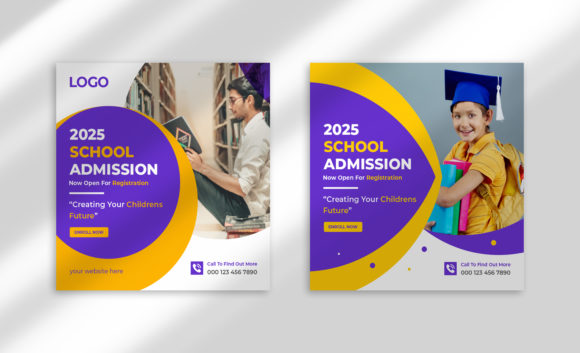
However, efficiency should never come at the cost of relevance. While templates provide a skeleton, the flesh of the content must be authentic. Avoid the trap of using stock photography that feels disconnected from your actual school environment. Instead, use the template structure to frame real photos of your students, teachers, and campus. This authenticity creates an emotional connection that generic imagery cannot replicate. Remember, the preview images in a template package are illustrative; the power lies in replacing them with your own narrative.
Technical considerations are also part of the operational strategy. Ensuring your files are in the correct format (such as RGB for digital display) and resolution (typically 1080x1080 for Instagram and Facebook feeds) guarantees that your message looks crisp on all devices. A pixelated or poorly formatted image can inadvertently signal a lack of professionalism, undermining the very trust you are trying to build.
Risks of Generic Implementation and How to Avoid Them
While templates offer convenience, relying on them without a strategic framework can lead to diminishing returns. The primary risk is homogenization. If your School Admission Social Media Post Design looks identical to dozens of other schools using the same popular template, you lose your distinct identity. To mitigate this, customization is non-negotiable. Adjust color palettes to match your specific brand guidelines, modify typography to reflect your school's character, and ensure that the hierarchy of information prioritizes what matters most to your audience.
Another significant risk is the disconnect between design and data. Posting beautiful graphics without tracking their performance is an exercise in vanity. You must analyze which designs generate the most engagement, clicks, and inquiries. Did the post featuring the science lab outperform the one featuring the sports field? Use these insights to refine future designs. Strategic design is iterative; it evolves based on feedback and results.
Additionally, be wary of over-designing. A common mistake is cramming too much text or too many graphical elements into a single square format. Social media users scan content quickly. If your message is not immediately clear, they will move on. Embrace white space. Let the design breathe. The goal is to guide the eye, not overwhelm it. Simplicity often conveys confidence and clarity, whereas complexity can suggest confusion.
Long-Term Value and Brand Equity
Ultimately, the investment in thoughtful School Admission Social Media Post Design contributes to long-term brand equity. Consistent, high-quality visual communication reinforces the perception of your institution as a leader in education. Over time, this cumulative effect strengthens your reputation, making it easier to attract not only students but also top-tier faculty and community partners.
Moreover, a well-maintained social media presence serves as a living archive of your school's culture. Prospective families often scour past posts to get a feel for the daily life of the institution. A history of professional, engaging, and diverse content provides social proof that your school is active, vibrant, and well-managed. This depth of content can be the deciding factor for a parent weighing multiple options.
To maximize this long-term value, treat your social media strategy as a marathon, not a sprint. Plan your themes months in advance, aligning them with the academic calendar and key admission milestones. Ensure that every piece of content, from the initial teaser to the final reminder, adheres to your established design standards. This discipline ensures that your brand remains top-of-mind throughout the entire decision-making lifecycle of your audience.
Making Intentional Design Decisions
Moving forward, approach every design task with a question: "What outcome am I trying to achieve?" If the answer is unclear, the design will likely fail to perform. Whether you are announcing a new program, sharing a testimonial, or reminding parents of a deadline, let the goal dictate the design choices. Use bold headers for urgent news, softer tones for community stories, and clear, contrasting buttons for calls to action.
By treating School Admission Social Media Post Design as a strategic asset rather than a cosmetic afterthought, you empower your institution to communicate with greater impact. It is about making better decisions regarding how you present your story to the world. When design, strategy, and authenticity converge, the result is a compelling narrative that resonates with families and drives meaningful enrollment results.
In conclusion, the tools available today, from editable AI files to responsive templates, provide an unprecedented opportunity for schools to elevate their marketing game. However, the tool is only as effective as the hand that wields it. By applying strategic thinking, maintaining brand consistency, and focusing on the needs of your audience, you can transform simple social media posts into powerful engines for growth and community building.